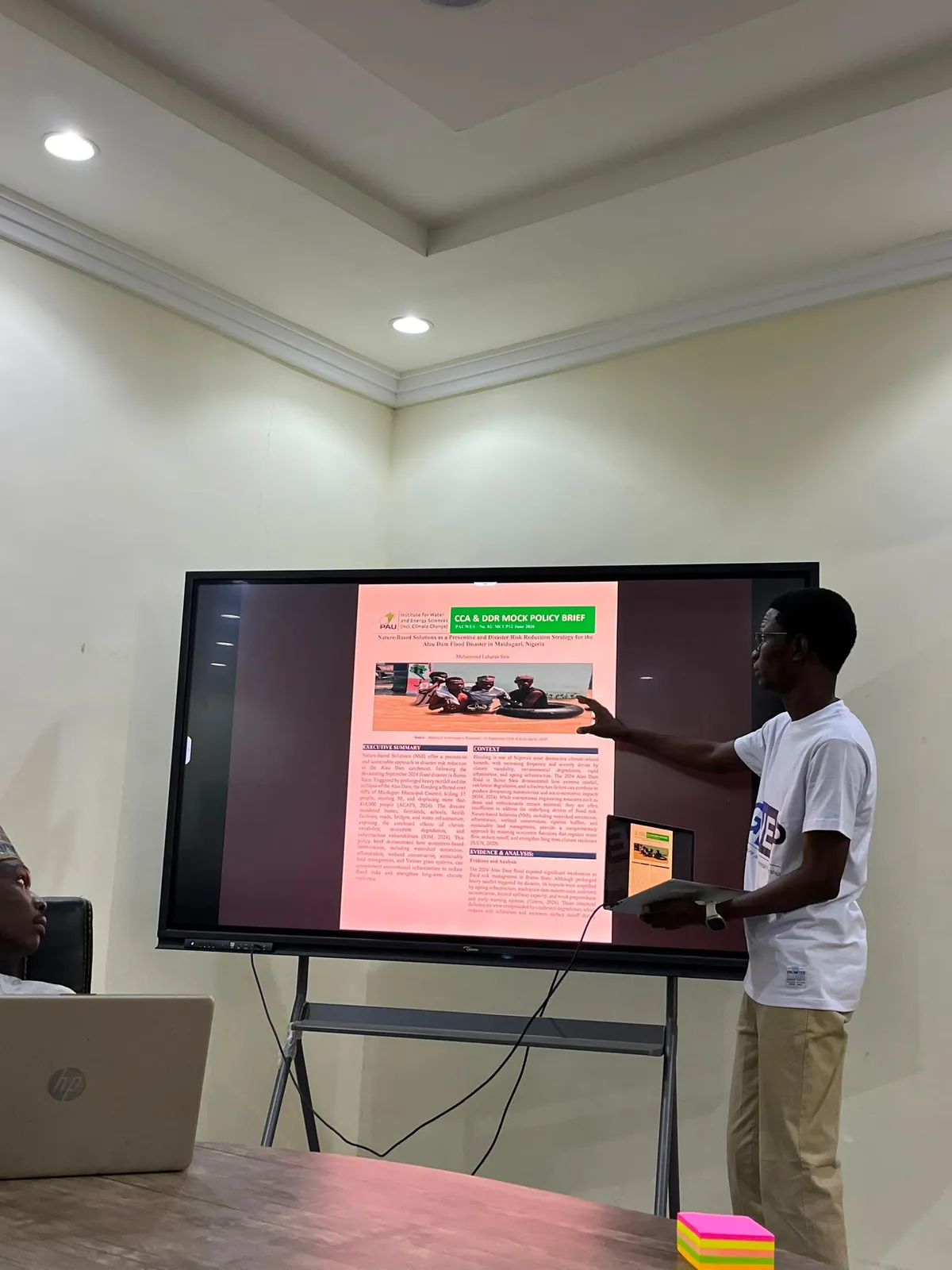
Environmental challenges require more than public awareness and good intentions. Addressing climate change, biodiversity loss, land degradation, water insecurity and other sustainability concerns also requires decisions informed by credible evidence, an understanding of local realities and a clear appreciation of available policy options.
Research can help identify the causes of environmental problems, assess the effectiveness of existing interventions and highlight opportunities for improvement. Yet research does not automatically influence public policy. Findings must be communicated clearly, connected to institutional priorities and presented in ways that help decision-makers understand what action is needed.
For civil society organisations (CSOs), the challenge is therefore twofold: generating or accessing reliable evidence and translating that evidence into practical recommendations that can inform policy and implementation.
Strengthening this connection is essential to effective environmental governance in Nigeria and across Africa.
Why Evidence Matters in Environmental Governance
Environmental decisions often involve competing priorities, limited resources and complex relationships between social, economic and ecological systems. Policymakers may need to balance agricultural production with ecosystem protection, expand energy access while reducing environmental harm, or determine how scarce public resources should be allocated to climate adaptation.
In such circumstances, evidence can help clarify the nature of a problem and identify which responses are most appropriate.
For example, information on flood exposure can help authorities identify vulnerable locations and improve preparedness. Research on tree survival can inform restoration programmes and guide the selection of suitable species. Assessments of climate finance can help identify barriers that prevent resources from reaching vulnerable communities.
Evidence also provides a basis for accountability. By comparing stated policy objectives with implementation records and observed outcomes, civil society organisations can ask whether commitments are being fulfilled and whether interventions are delivering their intended benefits.
However, evidence-based policy engagement is not simply about presenting statistics. Evidence must be relevant to the decision being considered, sufficiently reliable for its intended use and interpreted in its proper context.
The Gap Between Research and Policy
A persistent challenge in environmental governance is the distance between research production and policy implementation.
Academic studies may contain valuable findings but remain difficult for non-specialist audiences to access or interpret. Technical reports may describe environmental risks without clearly identifying the institutional responsibilities or policy changes required to address them. Meanwhile, policymakers and public institutions often operate under time, budget and administrative constraints that make lengthy research documents difficult to use in day-to-day decision-making.
Civil society organisations can help bridge this gap by translating research into accessible, focused and actionable communication.
This process begins with identifying a specific policy problem. Rather than attempting to communicate every finding from a broad research project, organisations should determine which evidence is most relevant to the decision at hand.
They can then explain the significance of the findings, identify the institutions responsible for responding and develop recommendations that are practical within the relevant legal, financial and administrative context.
The objective is not to oversimplify research. It is to preserve the integrity of the evidence while making its implications understandable and useful.
From Research Findings to Policy Recommendations
Turning research into action requires a deliberate process that connects evidence with decisions and implementation.
First, define the policy question. Organisations should identify the problem they want to address and the decision or institutional process they hope to influence. A clear question helps determine what information is needed and prevents research from becoming disconnected from practical priorities.
Second, identify credible evidence. Relevant sources may include peer-reviewed studies, government reports, administrative data, community consultations, environmental assessments and publications from recognised research institutions. Organisations should assess the quality, date, limitations and relevance of each source.
Third, interpret the findings in context. Evidence should be considered alongside local conditions, institutional responsibilities and the experiences of affected communities. Where findings are uncertain or conflicting, these limitations should be acknowledged.
Fourth, develop feasible recommendations. Recommendations should identify what needs to change, which institution or stakeholder could act, and what resources or coordination may be required. Broad calls for greater awareness or stronger commitment are often insufficient without practical steps.
Finally, communicate strategically and follow up. Research findings can be translated into policy briefs, evidence summaries, stakeholder presentations, public dialogues and formal submissions. Engagement should be followed by efforts to understand whether recommendations were considered, adopted, adapted or not acted upon.
This process helps organisations move from describing an environmental challenge to supporting a more informed response.
The Role of Policy Briefs and Accessible Communication
A policy brief is one useful tool for connecting research with decision-making. Unlike a lengthy academic paper, it focuses on a defined policy problem, summarises the most relevant evidence and presents a limited number of actionable recommendations.
An effective policy brief generally answers four questions:
What is the problem, and why does it matter now?
What does the available evidence tell us?
What are the implications for policy or implementation?
What specific actions should relevant institutions consider?
Clarity is essential. Recommendations should be specific enough to guide action, while remaining realistic about institutional capacity, available resources and political constraints.
Other communication formats can serve complementary purposes. Infographics may communicate key findings to wider audiences, stakeholder dialogues can help test recommendations against practical experience, and community meetings can ensure that research reflects the priorities of affected populations.
The appropriate format depends on the intended audience and the decision that needs to be influenced. A technical audience may require detailed methods and data, while senior officials may need a concise account of the main findings, implications and recommended actions.
Connecting Research with Community Knowledge
Evidence-based policy engagement should not rely exclusively on published studies or official datasets. Community knowledge can help researchers and advocates understand how environmental policies operate in practice.
Farmers, community leaders, women, young people and other local stakeholders may have direct experience of changes in rainfall, land use, water availability or access to natural resources. Their perspectives can help identify issues that formal data overlook and reveal how policy decisions affect different groups.
Combining community knowledge with credible scientific and administrative evidence can produce a more complete understanding of environmental challenges.
This requires careful engagement. Community perspectives should be collected ethically, interpreted fairly and represented accurately. Individual accounts should not be treated as conclusive evidence of a wider pattern without appropriate corroboration.
When these sources are combined responsibly, policy discussions can become more responsive to local realities and better informed by the people most affected by environmental decisions.
Strengthening Civil Society's Capacity for Evidence-Based Engagement
Civil society organisations need more than access to research. They require the skills and institutional systems necessary to assess evidence, communicate findings and sustain engagement with relevant institutions.
Capacity development can support this work through training in research methods, data interpretation, policy analysis, policy brief writing, project development and persuasive communication.
Partnerships with universities, independent researchers, journalists and technical organisations can also help CSOs access expertise and strengthen the credibility of their work.
For smaller organisations, collaboration can be especially valuable. Sharing research resources, jointly organising stakeholder dialogues and working with subject specialists can reduce duplication and improve the quality of policy engagement.
The use of digital tools and artificial intelligence may also support literature discovery, document organisation and the preparation of initial summaries. However, these tools should complement rather than replace critical assessment. Organisations must verify claims against original sources, check references and protect confidential information.
Ultimately, credible policy engagement depends on transparency, sound reasoning and a willingness to distinguish established findings from assumptions or recommendations.
GNEP's Approach to Research and Policy Engagement
The Global Nature and Environmental Partnership (GNEP) recognises that effective environmental action requires a connection between knowledge, community participation and policy engagement.
Its work includes capacity-building activities designed to strengthen civil society representatives' skills in policy brief writing, proposal development, persuasive communication and the use of research tools. These capabilities can help organisations articulate environmental concerns, develop clearer project ideas and engage more effectively with relevant stakeholders.
By promoting research-informed advocacy alongside environmental education and community-oriented action, GNEP seeks to support a stronger role for civil society in sustainability and climate resilience.
The broader objective is to encourage environmental engagement that is not only visible but also informed, constructive and connected to practical responses.
Conclusion: Making Evidence Count
Research can improve environmental policy, but its influence depends on how findings are interpreted, communicated and used. Evidence must be connected to clearly defined problems, realistic recommendations and the institutions responsible for action.
Civil society organisations can play an important role in this process by bringing together research, community experience and policy engagement. Through credible communication, constructive dialogue and sustained follow-up, they can help ensure that environmental decisions are better informed and more responsive to public needs.
For Nigeria and other African countries confronting complex environmental challenges, strengthening the relationship between research and policy is an important step towards more accountable governance and sustainable development.
The ultimate value of research lies not only in what it reveals, but also in how effectively its findings help society make better decisions.
About GNEP
The Global Nature and Environmental Partnership (GNEP) is a youth-led environmental initiative working to advance sustainability, climate resilience, environmental education and nature-based solutions across Africa, with community-oriented activities in Katsina State, Nigeria.